top of page

BLOG

To behold the Himalayan Apis Laboriosa foraging on the Rhododendron flowers and convert the collected nectar into Mad Honey is a one-of-a-kind experience. These highland bees possess genes that are perfectly compatible with the ‘invasive’ flowers which carry grayanotoxin.

ree

The honey produced with grayanotoxin components is a precious nectar that is usually hard to find. And unless you are getting it from here, there is no guarantee that commercial mad honey is not over-processed or simply altered with cheaper kinds of honey.


According to the golden rule of sweetness, the value of honey can be deciphered by the following:

  • The overall quality ( raw, pure, or altered).

  • The region and climate in which the bees operate.

  • And the flora and fauna.

Lali Guransh, an Atypical National Flower

The story behind the production of mad honey is fascinating and unusual. Mad honey is not only about the bees, the honey hunters, but also much about the magic of the cosmos. The Rhododendron flower aka Lali Guransh, the national flower of Nepal largely contributes to the 'mad' properties of mad honey.

Rhododendrons are known for being noxious to humans, however, honey produced from the latter has psychoactive attributes and is largely used for its medicinal and recreational properties in Nepal.


Rhododendron stems are even used in dishes as the plant is believed to possess curative properties. The honey produced from the lali guransh is said to be effective in treating anxiety, insomnia, diabetes, and much more.

Grayanotoxins are toxins produced by rhododendrons and plants of the Ericaceae family. Ericaceaes consist of flowering plants that flourish in infertile growing conditions. This type of plant can be recognized by its leaves which are generally arranged along the stems; flowers usually grow in solitary or clusters with 5 petals, 5 sepals, and 10 stamens.


The Mad Honey Bees that Consume Grayanotoxin

Some types of rhododendron can contain up to 25 different types of grayanotoxin. The giant bees have become accustomed to the existing potent neurotoxin of the Lali Guransh and to them, it is merely a food source; the nectar is carried to the hive where potent mad honey is produced in oblivion.


Contrary to most bees who cannot ingest the rhododendron nectar, the Apis laboriosa has adapted to the highlands and has developed some sort of immunity to grayanotoxin. Hence, the bees are not intoxicated and neither are the humans who consume the Nepalese Mad Honey.


Rhododendron Luteum and Rhododendron Ponticum


The Rhododendrons are grown almost everywhere across the globe, however, it is essential that the giant Nepalese bees forage on the Rhododendron Luteum and Rhododendron Ponticum to produce what is known as mad honey.


The factor that primarily differentiates Nepalese mad honey from the Turkish lies in its conception - the rhododendron flowers flourish independently and are not cultivated in the Nepalese region as they are part of the scenery like the giant honey bees.


Seasons Influence the Potency of Mad Honey


The giant honey bees produce three types of honey; depending on the season, the level of grayanotoxin varies. The most potent form of honey is produced from the flowers at higher altitudes and is one of the rarest and most luxurious types of honey in the world. You can try it out here.


The honey that is harvested in autumn is cheaper since it is created from the Rhododendron present at all sites. This honey is more common and is sold at an average price. It is mainly harvested during late spring and autumn. It is renowned for its regenerative properties.

The most potent form of honey is produced from the Rhododendron flowers in Spring, at higher altitudes and is one of the rarest and most luxurious types of honey in the world.


The Mad Honey Limited Reserve


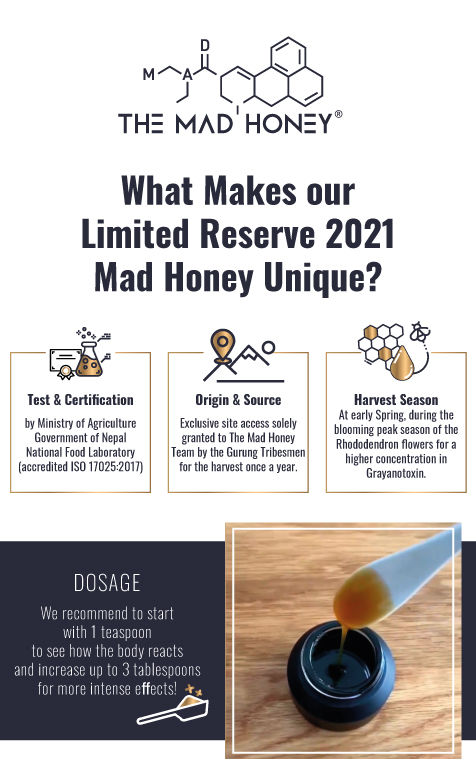
According to our customer reviews, The Mad Honey Limited Reserve, harvested in spring 2021, possesses a higher concentration of grayanotoxin leading to an elevated experience of the mad honey tasting.

Mad honey that is harvested in Autumn is cheaper since it is produced from the Rhododendron flowers present at all sites.

When it comes to the honey itself, the difference in taste can be as subtle as in the wine-tasting world. For instance, Manuka honey has a fuller consistency and an earthy, mineral-y taste whereas pure Himalayan mad honey has a slightly bitter aftertaste and has a more watery consistency which is why it spreads easily on the skin.

Depending on the harvest season, the potency of Mad Honey varies. See our FAQs to learn more.


If you’re fascinated by the lush scenery created by Rhododendron flowers, we recommend reading the following:


Note: We recommend experimenting with our two products, the Himalayan Mad Honey and the Limited Reserve 2021 Mad honey to assess both and appreciate your favorite.

MAD HONEY Limited Reserve 50g
Buy Now

HIMALAYAN HONEY 200g
Buy Now
HIMALAYAN HONEY 250g
Buy Now
MAD HONEY Limited Reserve 200g
Buy Now


Mad honey is not your ordinary shelf-bought honey although it can be easily mistaken for a harmless nectar; it is packed with power and potency. Mad honey tastes best when tried in a wooden spoon as it doesn’t modify the taste and properties in any way. We are not the only ones who recommend eating it this way, expert beekeepers think alike. However, any spoon is just fine but leaving a metal spoon dipped in overnight is a no-no, since honey has an acidic pH and reacts with metallic surfaces. So enough rambling, let's talk about the properties of Mad Honey and more.

ree

How to Recognize Authentic Mad Honey?

As we earlier mentioned in our previous article, The Higher the Mountain, The Madder the Honey, authentic mad honey does not taste like store-bought honey, although it is sweet, it has a bitter aftertaste- the smell is different and will remind you of ‘sugarcane wine’ known as Fangourin. It will not only bring some sweet memories but also titillate your taste buds due to its unusual yet delightful taste.


ree

Authentic mad honey can be recognized by its darker color, however a lot of mad honey brands that are available online claim to be selling pure mad honey without up-to-date lab tests and certifications.

This is why we recommend buyers seek in-depth information when investing in this elixir.

The Mad Honey has its Nepalese honey tested in laboratories.


Our latest certification was received on the 15th February 2021. Our Mad Honey is certified Himalayan Wild Honey from the Ministry of Agriculture Government of Nepal and is regularly tested by the National Food Laboratory. More on our Lab Report here.


Authentic Mad Honey Characteristics

Cliff honey can be recognized by its runnier consistency and deeper shade of red; it produces a slightly itchy sensation in the back of the throat when gulped down.


If you have tasted mad honey that didn’t sound like anything of the above, you’ve probably wasted your cash on altered mad honey or simply regular honey. It is easy to get scammed if you have no prior knowledge about Mad Honey so, if you are skeptical about the authenticity of our Mad Honey, read our customer reviews or simply get in touch with us on What’s App/ Telegram, Facebook, or via email for assistance.

Transparency and accountability are key principles of our brand, therefore we are here to answer all of your questions and assure the best tasting and psychoactive experience with our cliff honey.


How Much Mad Honey Should You Take?

For the Gurung Tribesmen who are used to the Nepalese nectar, it is not unusual to go beyond the recommended dosage, however, we would recommend one spoonful a day for medicinal purposes. If it is your first time trying Mad Honey, it is best to start with one teaspoon and step up to two spoonfuls once your body is acquainted with this new experience.


The dosage of grayanotoxins in a spoonful of mad honey varies from place to place and season. For instance, our Mad Honey Limited Reserve 2021 is more potent than our regular Mad Honey, this is mainly because the harvest takes place in Spring where the Rhododendron flowers are in full bloom, which in turn signifies that the foraging bees produce honey with higher potency and psychoactive properties.


The experience provided by The Mad Honey is a pleasant and predictable one, our quality is backed up by years of experience in the field. We test the harvested honey and can therefore guarantee that every teaspoon of The Mad Honey carries a potent amount of grayanotoxins.

Our Himalayan Honey can be used daily as an immune system booster as it stimulates cell regeneration. For our Mad Honey Limited Reserve 2021, 2 or 3 tablespoons will produce mild effects within 20 minutes to 1hour. The effects last anything between 3 to 5 hours.


What are Mad Honey effects?

Experienced effects are sensations such as body relaxation, brain consciousness and a surge of energy, a sense of euphoria, and alteration in colors and brightness.​


More delicate and reactive bodies can also experience queasiness, dizziness, blurred vision, wilting and increased blood pressure.

For stronger effects, we recommend eating The Mad Honey on an empty stomach.

It is best to avoid drinking alcohol before or right after the intake of The Mad Honey.

We do not recommend increasing the dosage by more than 3-4 tablespoons.


Other ways to use Mad Honey

Put your fancy pants on! Since mad honey is fancy and on the pricier side, you can save it for a unique gastronomic dish. However, it is best not to expose mad honey to high temperatures since it alters its properties. Therefore, we recommend trying it out on a cheeseboard. Imagine having some Burrata with our mad honey? Mouthwatering, right? You can also consume mad honey with your tea. One teaspoon should suffice.


For Whom?

For the ones that are looking to spice up their lives or want to benefit from the medicinal properties of Mad Honey. Mad honey is an amazing mood-up lifter and has provided a magical if not, mystical experience to many. It is also a luxurious addition to your skincare routine since it has antiseptic and antibacterial properties.


Take a quick look at our reviews for more.


Be mindful when trying Mad Honey, as it is always risky to consume more than three spoons a day.


Read More:


MAD HONEY Limited Reserve 50g
Buy Now
MAD HONEY Limited Reserve 2x50g
Buy Now
HIMALAYAN HONEY 200g
Buy Now
HIMALAYAN HONEY 250g
Buy Now


Hunting for honey with the Gurung community is a fascinating experience that allows outsiders to discover their hidden treasure aka the mad honey, at an altitude of more than 3000 meters while discovering their unique culture and way of life. By savoring their prized red honey that is traditionally and ethically harvested, you can experience an appreciation of the rich and abundant Nepalese cliffs without even traveling.


The Curio known as Nepalese Honey Hunters

The Gurung honey hunters are not your average country hunters; these men are among the bravest and most underrated heroes you have ever come across.

Twice a year, mad honey is harvested from the deadly Himalayan cliffs. The tradition of honey hunting has been handed down through generations. The knowledge of red honey hunting is sacred to the Gurung community and whilst this art seems to be rendered extinct, the few honey hunters who still subsist are ensuring that their cultural heritage is kept alive by leading the remaining youth who is still fascinated by honey hunting.


Not Your Next-door Bees

The Himalayan honey/cliff bees known as Apis Laboriosa or giant bees are the world's largest honey bees and can measure up to three centimeters in length. These exotic bees differ from other bee species in numerous ways:

  • Their forewings are over 12 mm in length.

  • Their nesting behavior is unique; nests are typically composed of a single comb built on overhangs on vertical cliffs.

  • Nests are commonly present in altitudes above 1200m. Their distribution is restricted to the Himalayas. The bees are most common in mountainous areas of Nepal, Bhutan, India, and some parts of the Yunnan province in China.

  • Every once in a year, the giant bees gather nectar from white rhododendrons flowers (Lali Gurash) that carry 'mad' characteristics.


Extraordinary Men, Ordinary Lives


The risk taken is no joke albeit it seems like a child's play to the Gurung hunters. The hunters wear little to no protective gear. Originally from Tibet, the hunters moved to the region in the Middle Ages.

They were predominantly subsistence farmers who carried small-scale production of vegetables and livestock and had minimum interaction with the outside world. Their village is at a distance of more than 48 hours of walk from the nearest main road.

''These are people who are very connected to their land, and they’re connected to the spiritual world that comes out of their land.” For a Nepalese Honey Hunter's Last Harvest, Friend and Filmmaker Ben Ayers'99 was there.-Emily McConville

The Process

Honey hunting is not an undistinguished exercise; the Gurung tribesmen perform a sacred ritual including an animal sacrifice known as a Puja to pay their respects to the forest gods for a safe honey hunt. The sacrificed chicken/ sheep/goat is then served as a meal to the head of the honey hunters who is responsible for climbing the rope ladder, extracting the honeycombs, and enduring the honey bee stings. Another meal is typically served after a fruitful harvest. The Annapurna cliffs are vicious and many have lost their lives during their attempts to collect this unique nectar. Their names have been engraved along the cliffs as a tribute to them.


It is common to get rid of wasps by lighting a fire and moving their comb somewhere else. Unsurprisingly, the same is done to drive cliff bees out of their honeycombs; dried leaves are lit, attached to wet ones so that the huntsmen can attach them to their rope and maneuver the smoke while climbing the cliff.


With the aid of a bamboo stick; the hunter works the nest vigorously so as to detach the honeycomb from the cliff. Simultaneously, another stick is used to direct a basket and catch the severed honeycomb. The art of honey hunting not only requires dexterity but also grit which few of us possess. Once the honeycomb is caught in the basket, it is lowered to the ground.


The red honey is consumed in its raw state and is divided among the remaining villagers. Cups of honey tea are served. The honey-hunting site is situated in a remote location that keeps it at bay from foreign exploitation.


The Mad Honey® Harvest

Our harvests take place twice a year for the Himalayan Honey and only once a year for the Limited Reserve to provide the best quality possible. The Mad Honey® believes in an ethical harvest that supports the abundance of this dwindling Nepalese community. Our dedicated on-site team in Nepal is part of the Mad Honey Community; this allows us to have insightful knowledge of the harvests and hunts. Thus, we are able to get our hands on the best quality of mad honey for you.


ree

Superior Honey That Makes you High

We are the first company to trade Mad Honey worldwide and offer an online shop with international delivery. We are experienced and offer a unique experience to each and every customer.

Think we are blowing own trumpets?

Check out our reviews.


MAD HONEY Limited Reserve 50g
Buy Now

MAD HONEY Limited Reserve 100g
Buy Now

MAD HONEY Limited Reserve 200g
Buy Now

We recommend:


bottom of page